The part you never see
What weeping tile does, and how it stops doing it
Weeping tile is the perforated pipe around the outside of the footing. Water enters through the perforations and is carried away, so it never builds up against the wall. When the pipe fills with silt or was laid without stone and fabric around it, the water simply stays where it is.
Age tells you a lot. Older Collingwood houses were drained with clay tile in open-jointed lengths, and many have quietly reached the end of it. Subdivision houses from the 1980s onward have plastic pipe, which does not rot — but plastic laid straight into clay backfill without filter fabric silts up just as effectively.
What lasts
The bedding, not the pipe
Clear washed stone around the pipe, filter fabric around the stone, and a fall that actually takes water somewhere.
Comparison
Old drain versus a replacement
| Original clay tile | Replacement drain | |
|---|---|---|
| Pipe | Short unglazed clay lengths, open butt joints | Continuous perforated pipe |
| Around the pipe | Often laid straight into native soil | Clear washed stone, all round |
| Silt protection | None | Filter fabric wrapped over the stone |
| Typical failure | Fills with fines; roots enter at the joints | Fines are held out of the stone by the fabric |
| Can it be inspected? | Rarely — usually no access point | Yes, if a cleanout is included |
If the trench is open anyway, a cleanout costs very little and means the next person to look at this house can check the drain instead of guessing. We include one where the layout allows it.
Upstream first
Do the surface water first
A new drain handles groundwater. It is not designed to swallow the entire roof of a house.
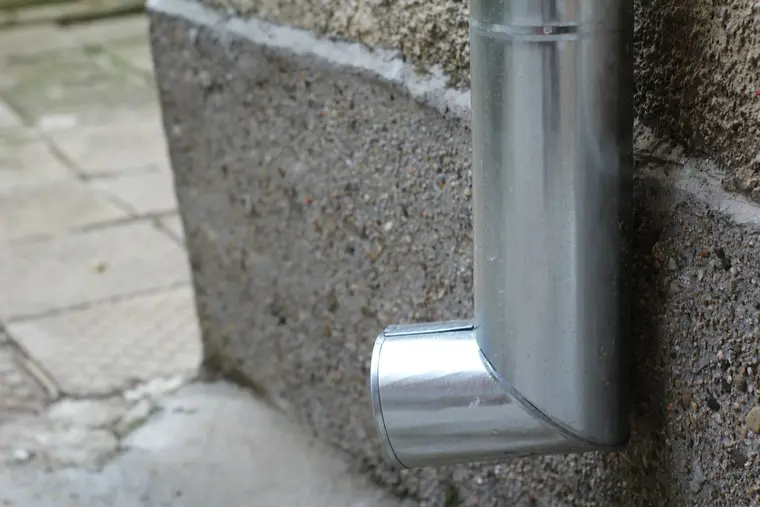
- Extend every downspout at least two metres from the wall, further on the uphill side.
- Re-establish grade that falls away from the foundation on all four sides.
- Give window wells a drain that connects to something.
- Keep snow piles off the foundation line — a real volume of meltwater.
We check all four at the assessment, because it changes what the drainage work has to handle.
Questions
Questions about weeping tile
How do I know my weeping tile has failed?
You cannot see it, so you read it from the symptoms: water appearing at the wall/floor joint after long wet spells rather than during heavy rain, damp that spreads along a whole elevation instead of at one point, and efflorescence low on the wall.
What is wrong with the original clay tile?
Older houses were drained with short lengths of unglazed clay pipe laid butt to butt with open joints. Silt gets in through those joints, roots follow the moisture in, and sections shift. In heavy clay the pipe is often full of fines rather than broken — which is worse, because it looks intact and drains nothing.
Is replacing the tile the same as waterproofing?
They are usually done together, because the wall is exposed anyway. Replacing the drain restores the route water takes away from the footing; the membrane keeps water out of the wall itself.
Can weeping tile be replaced from the inside?
Not the exterior tile. What is installed inside is a separate interior drainage system beside the footing, which does a similar job for the water reaching the wall base — see interior drainage.
Elsewhere